
Goodbye to London
Louis MacNeice on the move

Just arrived on my doormat is the latest, and second, issue of Free Bloody Birds, a new little magazine ‘printing new poems and essays about poetry’, edited by Alan Jenkins and Declan Ryan. Louis MacNeice turns up several times, which is always a good sign: there he is in Ange Mlinko’s essay on Derek Mahon, in Michael Hofmann’s poem for Michael Longley, and surely he’s somewhere in that fire in Paul Muldoon’s contribution.
And, of course, he’s there in John Clegg’s lovely essay on MacNeice’s London, of which more below. There’s also a superb series of poems by Leontia Flynn (who I wrote about here), an elegy for youth, called ‘Summer’:
Summer is fading
on literary ambition -
on my literary ambition
on the blood-congested drive

to conquer all readers
as not a but the poet,
marmoreal and timeless
to be referenced in every debate;
That first line, which is the first line of each poem, working its way down the page, comes from Larkin’s ‘Afternoons’. Perhaps Larkin was listening to MacNeice too. MacNeice creeps up on you, as I wrote the other day.1 Here is the beginning of Autumn Journal, the long poem he wrote in 1938:
Close and slow, summer is ending in Hampshire,
   Ebbing away down ramps of shaven lawn where close-clipped yew
Insulates the lives of retired generals and admirals...
As FBB's editors point out, though poets from Belfast and ‘the North’ are keen to claim MacNeice as ‘one of their own’, MacNeice ‘went to school and university’ in England and lived and worked in London ‘almost his entire adult life’. At the same time, John argues in his essay, MacNeice rarely wrote about living in London with the same roving magpie eye for he brought to places like Belfast and Birmingham.
Rather (John writes) ‘MacNeice writes at his best about London — writes, in fact, unforgettably about London — when he is leaving or entering it.’ John’s full explanation is ingenious: I won’t spoil it here. But, as he says, leaving or entering London also means being ‘on the train or on the road’, and MacNeice is the ‘first poet of things seen from that speed’: factories, the backs of houses, rubbish dumps and petrol pumps.2 I’m grateful to him, too, for singling out one of MacNeice’s best London poems, ‘Goodbye to London’, with its sad shift from long, plain sentence to lilting refrain:3
Having left the great mean city, I make
Shift to pretend I am finally quit of her
Though that cannot be so long as I work.
   Nevertheless let the flowers fall
   Fast from the flower of cities all.
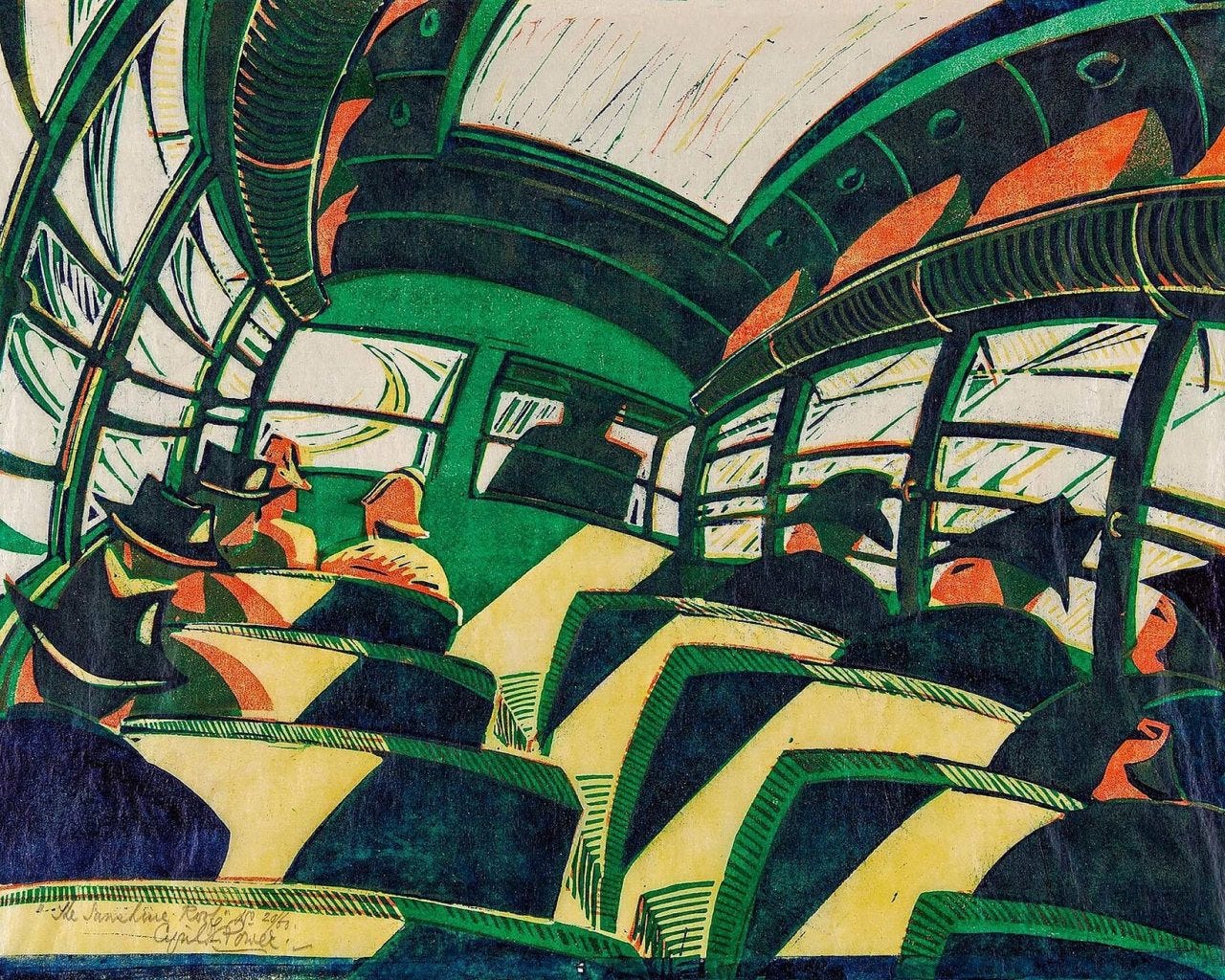
One addition from me, which only deepens the argument: some of my favourite MacNeice poems are not about leaving or entering London so much as passing through it. In ‘Charon’ for instance, which like ‘Goodbye To London’ is also from his last collection, a bus journey quickly turns into a nightmare:
The conductor's hands were black with money:
Hold on to your ticket, he said, the inspector's
Mind is black with suspicion, and hold on to
That dissolving map. We moved through London,
We could see the pigeons through the glass but failed
To hear their rumours of war, we could see
The lost dog barking but never knew
That his bark was as shrill as a cock crowing...
On the bus goes, past crowds of ‘aggressively vacant’ faces, towards the Thames where the bridges are down and the far shore lost in fog, at which point the conductor suggests getting the ferry. The ferryman is (of course) Virgil and Dante’s ferryman, his hands ‘black with obols’. Like the nightmare it is, ‘Charon’ is vivid but indistinct. It is a poem about not-seeing as much as about seeing. The map dissolves. The window is more than a window.
A similar kind of disassociation takes place in ‘Time for a Smoke’ (which I only read for the first time this week). MacNeice is standing outside the the British Museum, reflecting on all the ‘bottomless well’ of knowledge behind him, and on his childhood, when he remembers:
Still, I have time for a smoke. Striking a match,
My mind knows less about it than my hand
To which this town means mere rough and smooth,
Means moving handrails, knobs, revolving glass
Or the swing doors behind me which just now
It thrust to let its appended torso pass
It’s a portrait of London, all the more effective for being so strange: moving through the city is like being an assemblage of limbs. But then, MacNeice’s poems are always moving, even when they appear to stay in one place. He is always taking himself apart at the same time as he takes the world apart and puts it back together. Which is why, for some of us, he’s the modern poet.
While we’re here
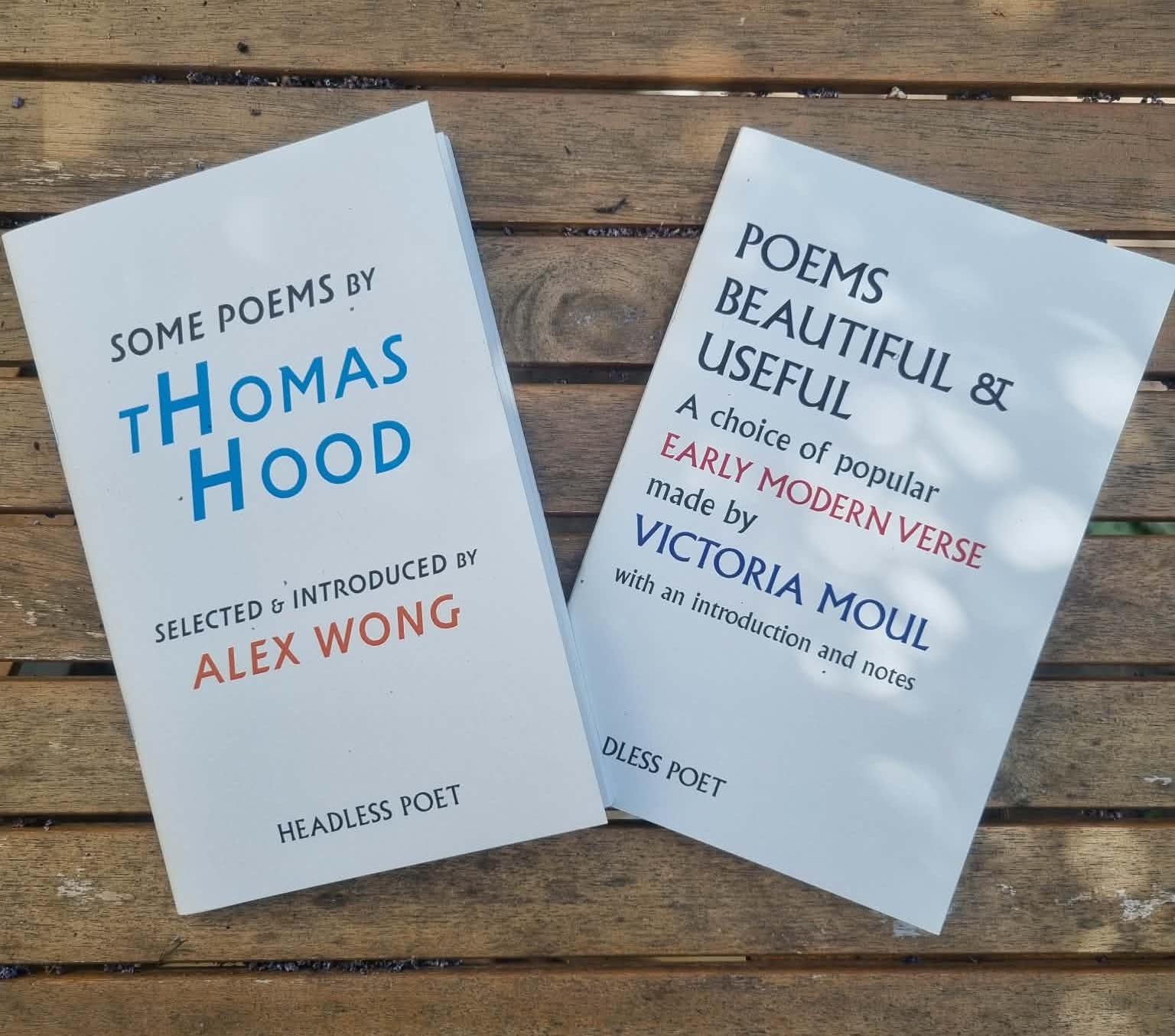
Regular readers might remember that I’ve started a poetry press ‘dedicated to the art of the introduction’. New subscribers (hello, thank you) might like an introduction. At its heart, Headless Poet is a physical subscription: I post you a slim pamphlet five times a year. Everything is designed and typeset in house, and printed by Angel Press, a small press in East London.
I’m very proud of the first two pamphlets, Victoria’s anthology of ‘beautiful and useful’ early modern verse and Alex Wong’s introduction to the poems of Thomas Hood. Next up: Jeremy Noel-Tod selects from the poetry of Lilian Bowes Lyon, one of MacNeice’s lesser-known contemporaries.
Readers in the UK can sign up here for a year’s worth (five) of pamphlets for £38, postage included. Single orders and international rates also available.
Mathew Lyons writes wonderfully about Autumn Journal here.
For those who (like me) didn’t know, ‘the flower of cities’ comes from Scots poet William Dunbar (b.1459/60), ‘In Honour of the City of London’.
Understandably, the trains are the mode of transport which get most of the attention in MacNeice’s work, here and elsewhere (trains are also essential to the history of the Middle Distance Poem). MacNeice is equally good on travelling by car, which is interesting because cars, supposedly, aren’t poetic: see Don Paterson’s quip about poets being bad drivers. That probably needs a whole essay in itself.
Thanks for the kind words! Louis does seem to be having a moment, doesn’t he? Long may it last. He’s been too long in Wystan’s shadow.
Quite brilliant how MacNeice introduces the ‘hand’ and then waits four lines before returning to it, as ‘It’, at the start of the line, giving us grammatically exactly that sense of automated dissociation he is describing.