

A little over a year ago I wrote a short piece about Philip Larkin’s ‘The Trees’. I was trying to explain why I don’t find the poem as sweetly poignant as it is sometimes taken to be. Statements like that last one are, of course, a little patronising. Can you really be tricked by a poem? Don’t we take what we like from them? And, if you can, why is it always other readers who are the dupes? Heaney himself praises ‘The Trees’ for its ‘beautiful equilibrium’:
Even in that short space… one can see the peculiar Larkin fusion of parsimony and abundance—the gorgeousness of ‘unresting castles’, the poignant sweetness of ‘afresh, afresh’ [which are] held in check by the quotidian…1
Parsimony and abundance — exactly. And as Henry Oliver points out in his generous response to my original piece, when Larkin compares ‘greenness’ to ‘grief’ he’s working in a recognisable tradition, as well as adding another number to his own series of bittersweet exclusions:
Somehow the trees do find a way of being young each year, though it hurts, like growing pains and the pains of seeing the past “smaller and clearer as the years go by”.
And yet. When I read ‘The Tree’ as a whole, I still think of it as one of Larkin’s ‘horror’ poems. I think this is because, in that last verse, the renewal that Larkin feels excluded from from is itself so eerie. In poems like ‘Sad Steps’, youth is at least ‘undiminished’ for others, but those fullgrown castles don’t seem like something anyone would ever aspire to be a part of.
The last line, in particular, is particularly creepy. As Julian Koslow put it, wonderfully, in the comments, the repetition of ‘afresh’ empties the word of its meaning: the poem reaches the ‘condition of song’, but the song is empty. And this is all the more disconcerting precisely because trees are so often, for Larkin, the symbol of the Good Life he’s been excluded from:
Even ... but why put it into words?
Isolate rather this element

That spreads through other lives like a tree
And sways them on in a sort of sense
And say why it never worked for me.
Like all good poems, then, ‘The Trees’ grows richer when it’s read in relation to other poems. Those relationships, in turn, makes the ‘horror’ both easier to recognise and to digest. In the original piece, I talked about Tennyson, because I was reading Tennyson. Henry spots T. S. Eliot, and as Victoria Moul points out, that grief / leaf rhyme is everywhere in English poetry. There are, as so often in High Windows, ‘“furtive memories of once having enjoyed some French symbolist poetry” (for which see Jeremy Noel-Tod here).
Then again, we don’t even need to look outside of the book. Perhaps the most obvious companion poem to ‘The Trees’, is ‘Cut Grass’, which is placed towards the end of High Windows. Both poems are made up of three four line stanzas. Both are about the seasons: ‘Cut Grass’ picks up in ‘young-leafed’ June where ‘The Trees’ left off in May).
In other respects, as David Rees notes, they couldn’t be more different. ‘The Trees’ is argumentative, where ‘Cut Grass’ is pure image:
Cut grass lies frail:
Brief is the breath
Mown stalks exhale.
Long, long the death

It dies in the white hours
Of young-leafed June
With chestnut flowers,
With hedges snowlike strewn,

White lilac bowed,
Lost lanes of Queen Ann's lace,
And that high-builded cloud
Moving at summer's pace.
This is so straightforwardly beautiful that I don’t think it needs much comment. But on we go all the same. There is an extended metaphor in the first few lines — grass as life and death — before the poem turn into a series of images, whiteness piled on whiteness. Larkin described the poem as ‘like music’ and said he heard a melody kicking in around line six. The chestnuts that were ‘unresting castles’ in May are simply flowers here. Nature isn’t threatening, perhaps because it’s dying.
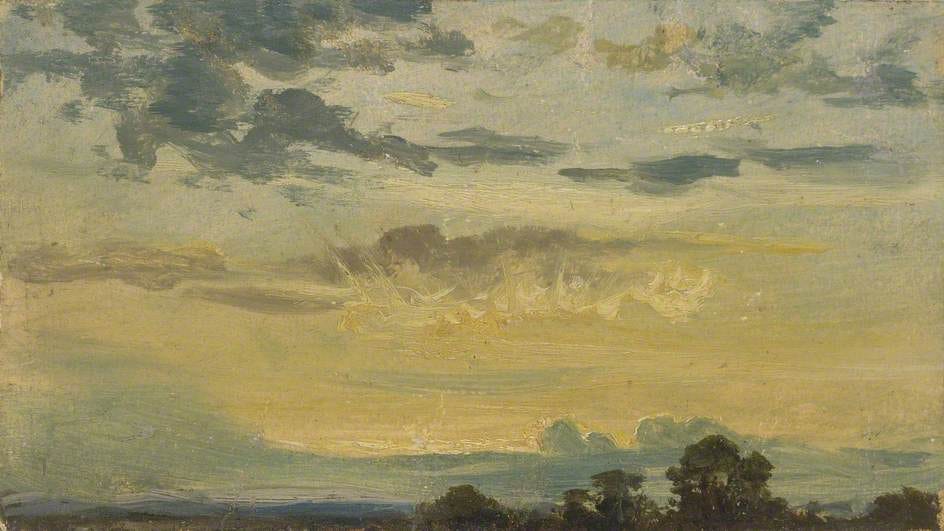
‘Cut Grass’ is one of Larkin’s little Edens.2 The poem is steeped in an Englishness which is both nostalgic (those lovely ‘lost lanes’) and hierarchical: the lilac is bowing, the cow parsley has its folkish, regal name. In that sense, it is a deeply conservative poem, but the politics is itself in service of the poem’s deeper myth-making, which is more about coming to terms with ‘the changing of the seasons’ than submission to any kind of human order.
The same trees also turn up midway through the book. ‘The Card Players’ celebrates the ‘secret bestial peace’ of a certain kind of Dutch painting:
Jan van Hogspuew staggers to the door
and pisses at the dark. Outside, the rain
courses in the car-ruts down the steep mud lane.
Inside, Dirk Dogstoerd pours himself some more,
Belching out smoke. Old Prijck snores with the gale…
For all that Larkin revels in the grossness and the puns, the poem really comes into its own when it zooms out:
Dirk deals the cards. Wet century-wide trees
Clash in surrounding starlessness above
This lamplit cave, where Jan turns back and farts,
Gobs at the grate, and hits the queen of hearts.

Rain, wind and fire! The secret bestial peace!
The ‘century-wide’ trees here (chestnut trees again, surely) aren’t playing a ‘trick’, and they don’t prompt much by the way of existential dread. Rather, they are the awesome context which makes the human warmth matter.
Finally then, in ‘Show Saturday’, the inhuman powers of renewal that so horrify Larkin in ‘The Trees’ become something we might yet be able to model. As the show packs up, and the crowds go home, Larkin compares the event to the spring. The symbolism is, if you like, back in a safe space:
Let it stay hidden there like strength, below
Sales-bills and swindling; something people do,
Not noticing how time's rolling smithy-smoke
Shadows much greater gestures; something they share
That breaks ancestrally each year into
Regenerate reunion. Let it always be there.
Perhaps following the line of trees in High Windows is a good analogy for the experience of reading Larkin in general. For all the bile, for all the horror, the experience isn’t, or needn’t be, misery inducing. ‘The Trees’ is, I want to suggest, one of the nastier moments — more akin ‘The Old Fools’ than a moment like ‘Solar’ — but it is also just one poem among several.
Larkin famously took great care over the ordering of his collections.3 But that attention only paid off because he kept returning to the same images. And though he often used those same images, including trees, throughout his life, High Windows is the collection in which they are at their most intense. In that sense, it is also his most complete work of art.4 Perhaps more to the point, Larkin, whose earliest ambitions were as a novelist, remained what he had set out to be: someone who thought in books, rather than individual poems.
While we’re here
Regular readers might remember that I recently launched a poetry publisher ‘dedicated to the art of the introduction’. New subscribers (hello, thank you) might like an introduction. At its heart, Headless Poet is a physical subscription: I post you a slim pamphlet five times a year. Everything is designed in house, and printed by Angel Press, a small press in East London.
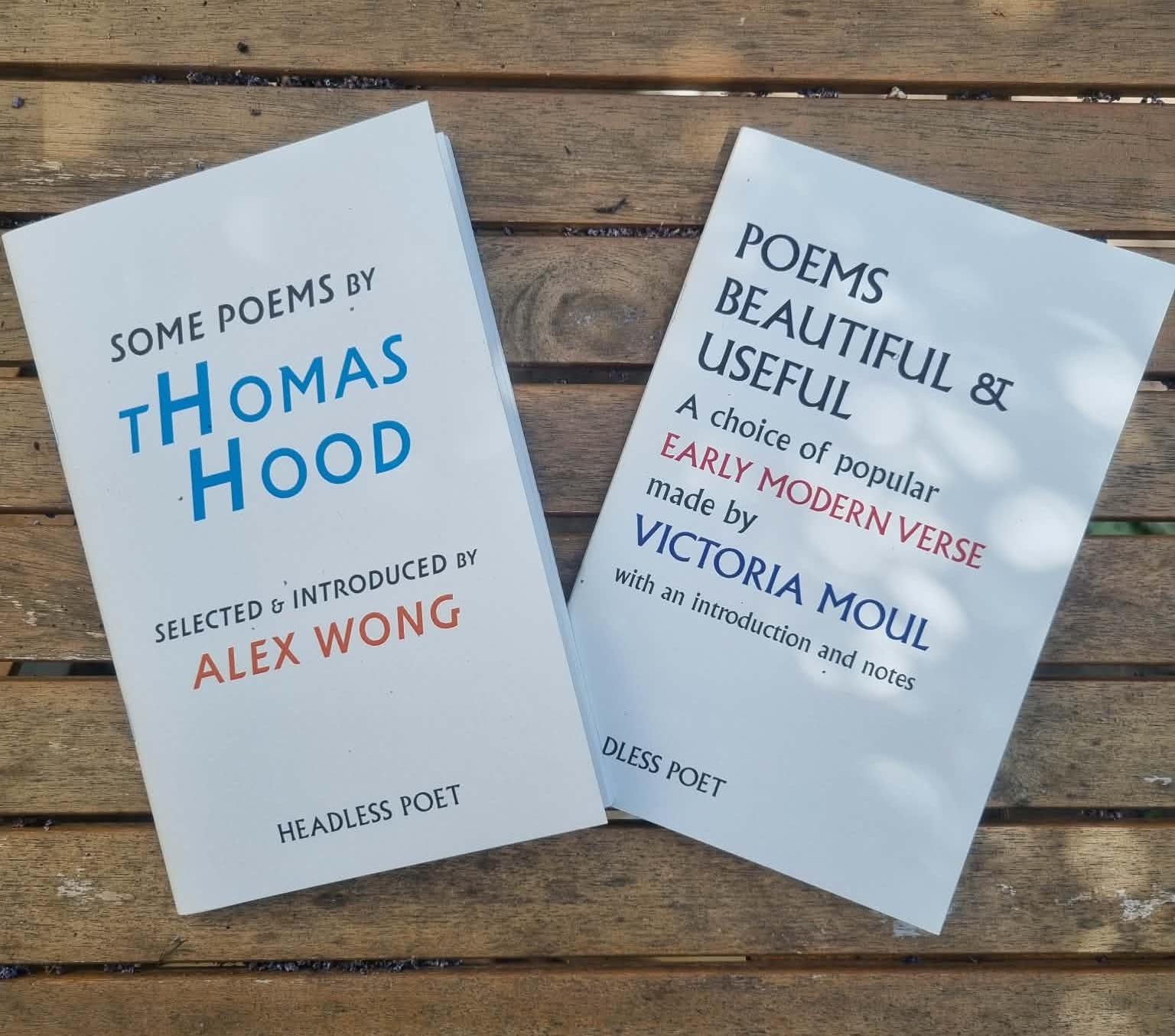
I’m very proud of the first two pamphlets, Victoria’s anthology of ‘beautiful and useful’ early modern verse and Alex Wong’s introduction to the poems of Thomas Hood (read an interview with Alex here).
Next up: Jeremy Noel-Tod selects from the poetry of Lilian Bowes Lyon, who Larkin—as it happens—included in The Oxford Book of Twentieth Century English Verse. Pre-orders for that one will open imminently.
In the meantime, readers can sign up here for a year’s worth (five) of pamphlets, UK postage included. Single orders and int. rates also available.
‘Englands of the Mind’, from Preoccupations: Selected Prose 1968–1978. The whole essay—on Hill, Hughes and Larkin as post-colonial poets—is fascinating and one of the best things I’ve read on Englishness in poetry (what do they know of England, who only England know etc).
See Barbara Everett’s essay ‘Larkin’s Edens’ in her collection Poets in Their Time. No one wrote better about Larkin than Barbara Everett.
I wonder if ‘The Trees’ was deliberately placed early, to get it out the way.
Though trees aren’t the most important symbol, overshadowed by the sun, light, coins, rooms and dwelling places. Again for Larkin and symbolism see Barbara Everett’s influential essay ‘Philip Larkin: After Symbolism’, also in Poets in Their Time.
I enjoyed this though I persist in loving this poem and I don’t hear it as you do at all. There are a lot of trees in Larkin’s early verse aren’t there? I thought particularly of this bit: Since I was not bewitched in adolescence And brought to love, I will attend to the trees and their gracious silence, To winds that move. And: This is the first thing I have understood: Time is the echo of an axe Within a wood. And: Is it a trick or a trysting-place / The woods we have found to walk? I’ll admit I love the early romantic Larkin, all angels and ill-disguised romantic longing to be an IMMORTAL poet in an anonymous Housmanian/Greek Anthology sort of way.
This is terrific. I dont quite see the folk-horror element in 'The Trees', but I think I see how you see it, if that makes sense. With Larkin it’s all in the ‘almost’, isn’t it (‘something almost being said’)? Even in less loaded contexts, ‘almost’ is a strange word emotionally, as it carries a burden of disappointment that doesn’t quite crush hope, even when it perhaps should. Logically, something ‘almost being said’ is something not being said, in the same way that something ‘almost true’ (Arundel Tomb) is in fact false. And yet we don’t feel it that way: it’s ‘almost’ as if the getting close is close to arrival (a sentiment Larkin elsewhere disowns : ‘A miss is as good as a mile’).
So in its modest way, perhaps, Larkin’s ‘almost’ is a gesture towards the Romantic sublime – the Wordsworthian sense of ‘something ever more about to be’ (which on one level, as someone pointed out, is something that never happens).
These feelings seem to be at least partly recognised in the recent online trope of ‘almost if’ or ‘almost like’ as obvious sarcasm, the subjunctive as false consciousness (‘It’s almost as if Trump were a complete loser’.) Yeah dude, it’s almost as if what will survive of us is love.